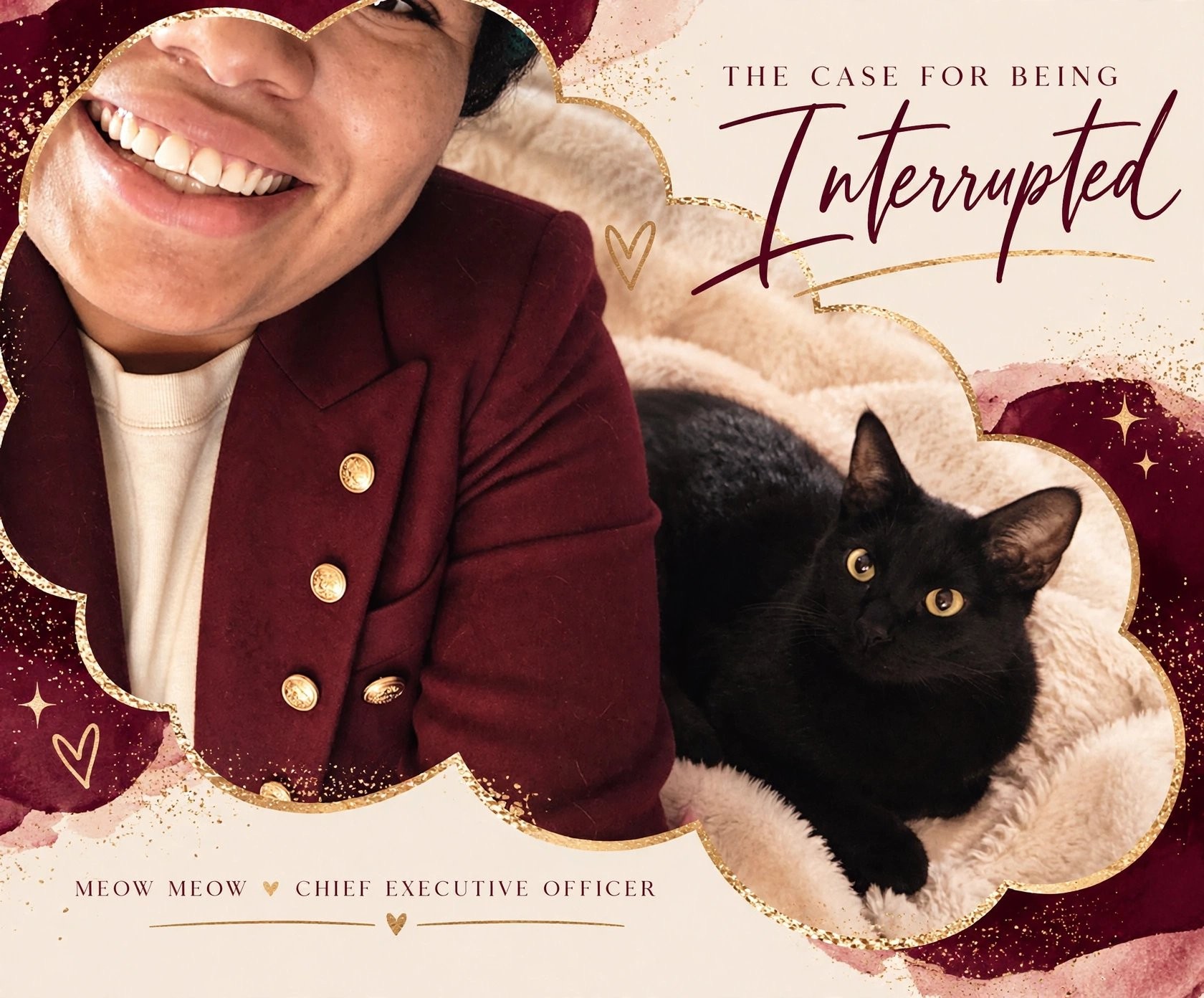
My home office has a CEO.
Her name is Meow Meow.
Her qualifications are outstanding, although admittedly difficult to verify. She has never answered an email, attended a meeting, or contributed a single dollar toward our household expenses. Nevertheless, she exercises remarkable authority over daily operations.
She is the self-appointed director of treat distribution, the chief compliance officer of scheduled affection, and an exceptionally persistent micromanager.
Her leadership style is unconventional. Her expectations are nonnegotiable. And her understanding of professional boundaries is, at best, questionable.
She also happens to be my cat.
Meow Meow has developed a particular fondness for my office chair. The moment I get up, she moves in. Occasionally, she doesn't even bother waiting for me to leave, choosing instead to squeeze herself behind me as though we have entered into some unspoken co-working arrangement.
And while I could characterize these interruptions as inconvenient, I've come to recognize something rather lovely about them.
They make my workday better.
The Paradox of Remote Work
Remote work has fundamentally reshaped our relationship with professional life. For many of us, it has provided something incredibly valuable: autonomy.
The ability to create our own environments, manage our responsibilities with greater flexibility, and participate in our personal lives without necessarily sacrificing our professional ambitions.
Yet flexibility and fulfillment are not interchangeable.
According to Gallup's State of the Global Workplace: 2026 Report, 30% of exclusively remote employees worldwide were engaged at work, compared with 25% of hybrid employees. Interestingly, when evaluating overall well-being, only 33% of remote employees reported thriving in their lives, compared with 45% of hybrid employees.
The distinction is fascinating.
Remote employees can report stronger engagement with their work while simultaneously reporting lower levels of overall life satisfaction.
Of course, these figures do not establish that remote work causes diminished well-being. They do, however, highlight an important distinction between being engaged in what we do and feeling fulfilled by the lives we lead.
And I wonder how much of that fulfillment is shaped by the little moments that never appear on a performance evaluation.
When Did Rest Become Another Productivity Strategy?
In 2022, researchers published a meta-analysis in PLOS ONE examining the effects of micro-breaks across 22 independent study samples involving 2,335 participants.
Their findings suggested that brief breaks could reduce fatigue and increase feelings of energy. However, the researchers did not find a statistically significant improvement in overall performance.
I find that second conclusion particularly interesting.
We live in a culture that has become remarkably skilled at justifying nearly everything according to its productive value.
We take walks to stimulate creativity. We practice mindfulness to improve concentration. We schedule breaks to prevent burnout so that we can return to work refreshed, focused, and ready to accomplish more.
Even our moments of rest are frequently evaluated according to what they can help us produce afterward.
But what if the value of an interruption has absolutely nothing to do with productivity?
What if sometimes, feeling better is enough?
The Joy in the Unscheduled
Meow Meow doesn't know what my calendar looks like.
She has no understanding of professional obligations, competing deadlines, or the carefully organized systems that help me navigate my responsibilities.
She does, however, understand that she would like my attention.
And so, somewhere between emails, meetings, and the seemingly endless responsibilities that accompany adulthood, I find myself negotiating office space with a little black cat who has decided that my chair is our chair.
Sometimes that means stopping to pet her. Sometimes it means laughing at the absurdity of being managed by an animal whose primary professional objective is ensuring her treats arrive on time.
Other times, it simply means sharing the space.
These moments are small. Almost insignificant when measured against the larger demands of a working day.
But perhaps that's precisely why they matter.
They interrupt the monotony without requiring anything particularly meaningful to happen. They provide companionship without conversation, affection without an agenda, and the occasional reminder that life continues beyond the screen.
I don't believe every interruption is beneficial, nor would I suggest that having a pet is a universal solution to the challenges of remote work.
But I do believe there is something worth examining in the ordinary rituals that make our working environments feel less transactional and more human.
A Different Measure of a Good Workday
I love the flexibility of working remotely. I appreciate the independence, the ability to structure my responsibilities, and the opportunity to build a professional life that exists alongside my personal one.
But increasingly, I'm learning that a successful workday doesn't have to be measured exclusively by the number of tasks completed, emails answered, or hours spent at a desk.
There is value in the work itself.
And there is value in the life happening around it.
Perhaps workplace happiness is not always found in another benefit, another optimization strategy, or another carefully designed productivity system.
Sometimes it exists in the smallest, most unscheduled moments of connection.
In the unexpected laughter.
In the quiet companionship.
In the little creature who has decided, with absolutely no formal appointment, that she is now in charge of the entire operation.
Meow Meow may never make a meaningful contribution to our quarterly objectives.
But she has certainly improved the company culture.
And frankly, I think that's worth recognizing.
Who runs your home office?
Research references
Gallup. (2026). State of the Global Workplace: 2026 Report.
Albulescu, P., et al. (2022). “Give me a break!” A systematic review and meta-analysis on the efficacy of micro-breaks for increasing well-being and performance. PLOS ONE, 17(8), e0272460.
Originally published on LinkedIn on October 15, 2026. Added to The Vibe Journal on October 18, 2026.